

Pool Building Insights From Northern Virginia's Custom Gunite Experts
The Custom Pool Education You've Been Looking For.
How to Know if Your Backyard Is a Good Fit for a Pool
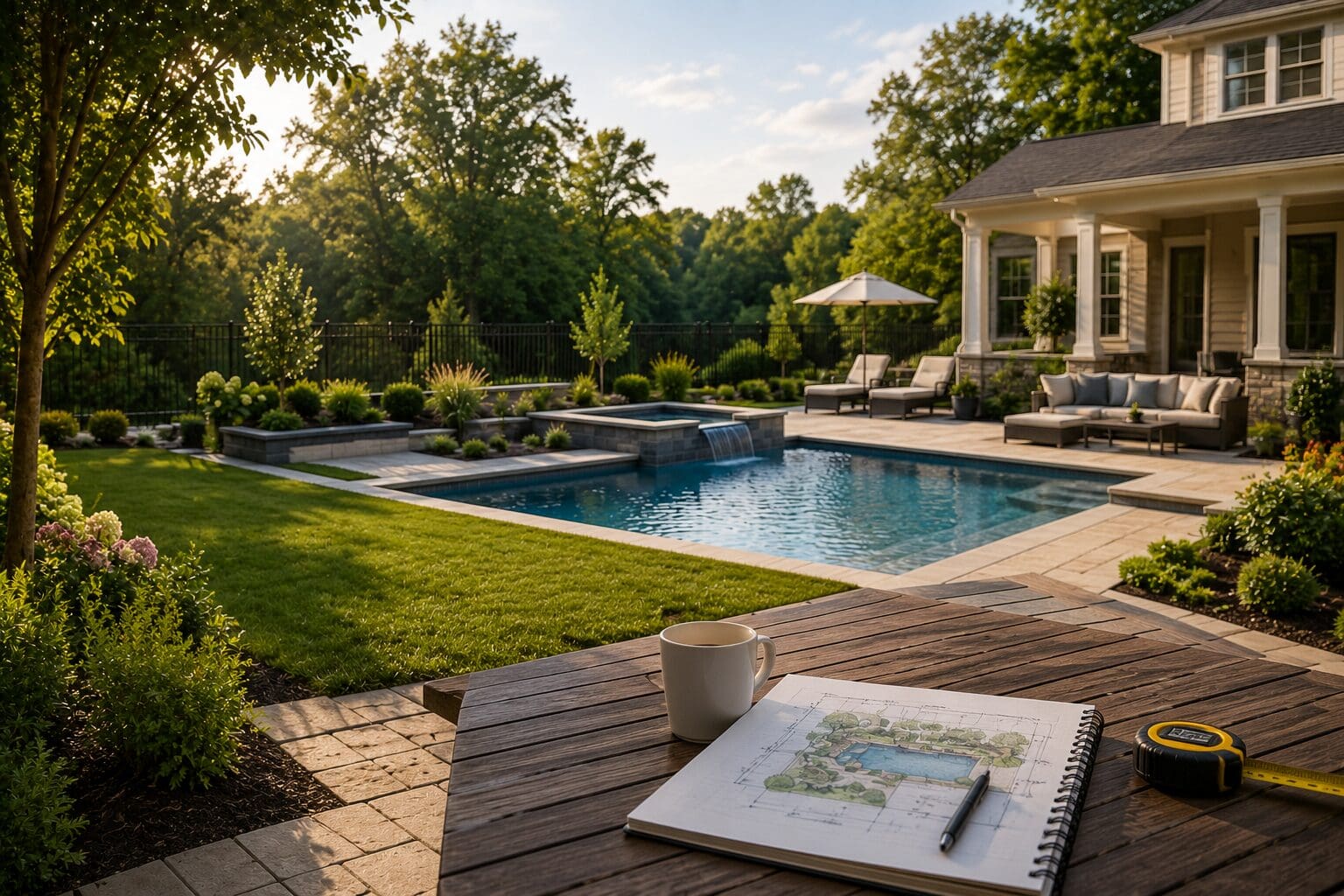
What to look at before you pick up the phone
Not every backyard is built for a pool. I say that not to discourage anyone, but because I think homeowners deserve an honest conversation about this before they spend an afternoon talking to builders.
In my years of building pools across Northern Virginia, I’ve walked properties that were nearly perfect for a pool and others where the honest answer was that it wasn’t going to work the way the homeowner was envisioning. The sooner you understand what you’re working with, the better decisions you’ll make.
This post is designed to help you do a realistic assessment of your backyard before you ever call a builder. Some of what I cover here will apply to your situation. Some of it won’t. But working through these questions will give you a much clearer picture of whether a pool is feasible on your property, what complications might affect the project, and what you might want to ask about when you do sit down with someone.
None of this replaces a proper site visit. But it’s a useful starting point.
Start With the Basics: Do You Have Enough Space?
This sounds obvious, but it’s the first thing I’m thinking about when I walk a property. How much usable, open ground is available for the pool itself plus the required setbacks and surrounding deck?
In most Northern Virginia jurisdictions, pools need to be set back a certain distance from your property lines, the house foundation, and any easements on your lot. These setbacks vary depending on whether you’re in Prince William County, Fauquier County, or another local jurisdiction, but as a general rule you should be thinking about a minimum clearance of ten feet from the house and five feet from the property line. These are rough guidelines, not code, so always verify with your county before drawing any conclusions.
Once you account for setbacks, how much room is actually left? A pool doesn’t exist in isolation. You need deck space around it to walk safely, dry off, and use the space comfortably. A pool that technically fits in a narrow yard with no room for people to move around it isn’t a pool you’re going to enjoy.
Take a walk around your backyard and try to identify the largest open, flat area. That’s your candidate zone. If that area is tight, it doesn’t necessarily mean a pool is impossible, but it does mean the design will need to work carefully within those constraints, and that affects what size and shape make sense.
How Does Your Yard Slope?
Slope is one of the most significant site factors in any pool project, and it’s one of the things homeowners least expect to matter as much as it does.
A gently sloping yard isn’t a dealbreaker. In fact, some slope can actually work in your favor if the pool is designed to work with the grade rather than against it. But significant slope requires grading work, retaining walls, or other structural solutions that add both complexity and cost to the project.
Here’s a simple way to start thinking about it. Stand at the spot where you’d want the pool and look across your yard. Is the ground relatively level, or is there a noticeable drop from one end to the other? If you’re looking at a yard that falls away sharply in one direction, that’s worth flagging when you talk to a builder.
Slope also affects drainage, which I’ll talk about in a moment. Water moves downhill, and where it goes when it rains matters a lot for how well a pool environment holds up over time.
Retaining walls can solve slope problems and, when designed well, they actually become a design element in the finished space. But they’re not free. If your yard has significant grade change in the area where you’re thinking about a pool, budget for that additional work in your planning.
Drainage: Where Does the Water Go?
I pay close attention to drainage on every property I visit. It tells me a lot about how a pool project is likely to go.
A yard that drains poorly, one where water pools after a rainstorm or stays saturated for days, can present challenges during construction and after. Excavation in very wet soil is harder and more expensive. Hydrostatic pressure from a high water table can affect the pool structure over time if it isn’t accounted for in the design. These aren’t problems that make a pool impossible, but they’re problems that need to be understood and addressed properly.
Walk your yard after a good rain and pay attention to where water collects. If you have low spots that tend to stay wet, note where they are relative to where you’d want the pool. If your whole yard seems to drain slowly, mention that to any builder you speak with.
On the flip side, the area around a pool will shed water, both from splash-out and from rain hitting the deck surface. That water needs somewhere to go. Good pool design accounts for deck drainage so water moves away from the pool, away from the house, and away from your property lines. This isn’t something most homeowners think about upfront, but it’s something every competent builder should be planning for.
Equipment Access: Can We Actually Get There?
This is one of the most commonly overlooked factors and one that comes up frequently in established Northern Virginia neighborhoods.
Building a gunite pool requires heavy equipment. An excavator has to get into your backyard to dig. Concrete trucks need access to pump or pour material. Pallets of material need to be moved onto the site. If that equipment can’t access your backyard without major obstacles, the project becomes more complicated and more expensive.
Walk your property and think about how anything large would get into your backyard. Is there a gate? How wide is it? Is there a side yard wide enough for a machine to pass through? Are there fences, mature trees, existing structures, or other features in the path?
A standard gate is rarely wide enough for excavation equipment. Many projects require temporary fence removal, which is manageable and something we plan for. But if there’s no viable access path at all, or if getting equipment in requires removing significant landscaping or crossing a neighbor’s property, that’s a complication worth surfacing early.
Tight access doesn’t make a pool impossible. It sometimes means using smaller equipment, which takes longer, or planning the construction sequence more carefully. But it does affect the project, and a builder who doesn’t ask about access during an initial conversation isn’t paying close enough attention.
Utilities, Septic Systems, and What’s Underground
What’s buried under your yard matters as much as what’s on the surface.
Before any excavation starts on a real project, we locate underground utilities. But in your early assessment, it’s worth thinking about what you know is back there. Electrical lines, gas lines, water and sewer service, irrigation systems, and drainage infrastructure all potentially run through your backyard. Pools need to stay a safe distance from gas lines in particular, and working around buried utilities adds complexity to the dig.
Septic systems are a significant consideration for homeowners in the more rural parts of our service area, particularly in Fauquier County and the outer edges of Prince William County. If your property is on a septic system, you need to know where the tank and drain field are located before you start talking about pool placement. Pools cannot be built over septic components. The drain field especially requires a meaningful setback, and in some cases the location of the drain field on a property significantly constrains where a pool can go.
If you’re on septic and aren’t sure exactly where your system is laid out, your county health department should have records. It’s worth pulling that information before you have any serious conversations with a builder because it directly affects what’s possible and where.
Well systems present similar considerations. If your water source is a private well, the wellhead location affects pool placement, and there are setback requirements that apply there too.
None of this is meant to alarm you. Most properties with septic and well systems can still accommodate a pool. But you need to know what you’re working with so the design starts in the right place.
HOA Rules and Deed Restrictions
If you’re in a homeowners association, which covers a significant portion of the communities in Gainesville, Haymarket, and the broader Prince William County area, understanding your HOA’s rules before you go any further is essential.
HOA regulations around pools vary widely. Some associations have no restrictions beyond what the county requires. Others have specific rules about pool placement, fence requirements, screening requirements, pump enclosures, lighting restrictions, hours of operation, and what materials can be used for decking and coping. Some associations require architectural review and approval before any pool project can begin.
The approval process through an HOA can take weeks or longer, and if your project doesn’t meet the association’s standards, you may need to redesign before you can get approval. Getting that process started early, ideally before you’ve finalized a design, saves a lot of time and potential frustration.
Pull your HOA’s architectural guidelines and look specifically for any language related to pools, outdoor structures, or site improvements. If the language is unclear, reach out to the HOA management company directly and ask whether there’s a formal process for pool approvals. Knowing this before you’re deep into design conversations with a builder means you’re not caught off guard.
Deed restrictions are a related consideration. Some properties have deed restrictions that aren’t enforced by an HOA but are still legally binding. If you’re not sure whether your property has deed restrictions, your title company or a real estate attorney can help you pull that documentation.
Trees, Landscaping, and What You’re Willing to Change
Mature trees are beautiful. They’re also one of the things that can most complicate a pool project if they’re in or near the build zone.
Tree roots extend well beyond the canopy of the tree, often in ways that aren’t visible from the surface. Excavating near mature trees can damage root systems, which affects the health of the tree and in some cases its structural stability. For this reason, pools generally need to be placed far enough from large trees that the root zone isn’t significantly disturbed during construction.
Leaf drop is the other issue. Pools near deciduous trees are constantly fighting organic debris. Leaves, seedpods, and pollen end up in the water, put additional load on the filtration system, and create more maintenance work for the homeowner. This doesn’t make it impossible to put a pool near trees, but it’s a real quality-of-life consideration that’s worth thinking about honestly.
Beyond trees, think about what else is in your backyard that would need to change. Existing sheds, playsets, gardens, patios, fencing, and landscaping all potentially need to be relocated, removed, or rerouted. Some of that work is simple. Some of it is meaningful cost that isn’t always factored into people’s early thinking about a pool project.
Ask yourself what you’re willing to change about your current backyard to make room for a pool, and what you’d want to preserve. That clarity helps a builder understand what they’re working with and helps you think realistically about the total scope of the project.
Thinking About the Sun
This one often gets missed in early planning conversations, and it makes a real difference in how much you actually enjoy your pool once it’s built.
Sun exposure affects water temperature, how quickly the pool heats up naturally, and how the space around it feels throughout the day. A pool that’s in full shade most of the day stays cold, which is frustrating if you were hoping for comfortable swimming without running a heater constantly. A pool in full sun all day can get uncomfortably hot in the peak of a Virginia summer, and the deck surface around it can become genuinely too hot to walk on barefoot.
The ideal is a pool that gets good morning and midday sun but has some relief from the most intense afternoon heat. That’s not always achievable given property layout, but it’s worth thinking about as you consider placement options.
Look at your backyard at different times of day and pay attention to how the sun moves across the space. Where does shade fall from the house? From neighboring structures or tree lines? That observation, even informal, is useful input when you start talking about where to position the pool on the property.
The Honest Assessment: What It Means for Your Project
If you’ve worked through all of this and feel like your property has a reasonable open zone, manageable site conditions, clear access potential, and no major regulatory constraints, that’s a good starting point. You’re ready to have a productive first conversation with a builder.
If you’ve identified some complications, that’s okay too. Most properties have at least one factor that requires some problem-solving. Slope, access, septic setbacks, and HOA processes are all things that can be navigated with the right planning. The key is knowing about them early.
Where I’d pump the brakes is if you’re looking at a property with very limited usable space, no realistic equipment access, an HOA with restrictive covenants you haven’t cleared, or a septic system that occupies most of your backyard. Those are situations where the feasibility conversation needs to happen before design and pricing conversations begin.
What I want to avoid is a situation where a homeowner has spent months imagining a pool and months talking to builders before someone finally says what should have been said in the first visit. That’s not fair to you, and it’s not how I like to do business.
What to Bring to Your First Builder Conversation
Once you’ve done this walkthrough, here’s what I’d suggest having ready when you talk to a builder.
- A rough sense of where in your yard you’re thinking about the pool
- Any survey or plat of your property that shows lot lines, easements, and existing structures
- Septic system records if you’re on a private system
- Your HOA architectural guidelines if you’re in an association
- A note of any access challenges you’ve identified
- A general sense of what features matter most to you
You don’t need all of this to start a conversation. But having any of it makes that first meeting more productive and helps a builder give you more useful feedback faster.
The Bottom Line
Most backyards in this region can accommodate a pool of some kind. The more important question is usually what kind of pool, at what scale, and with what constraints factored into the design. That’s a conversation I’m happy to have once we’re standing in your yard looking at what you’re working with.
A site visit takes an hour. It costs nothing. And at the end of it, you’ll have a much clearer answer to the question you’ve been sitting with than anything you’ll find by reading about it online.
If you’ve been wondering whether your backyard is pool-ready, reach out. Let’s go take a look.
Schedule a free site visit with Jake at Relax Pools of Nova.