

Pool Building Insights From Northern Virginia's Custom Gunite Experts
The Custom Pool Education You've Been Looking For.
What Is a Gunite Pool? A Simple Guide for Homeowners
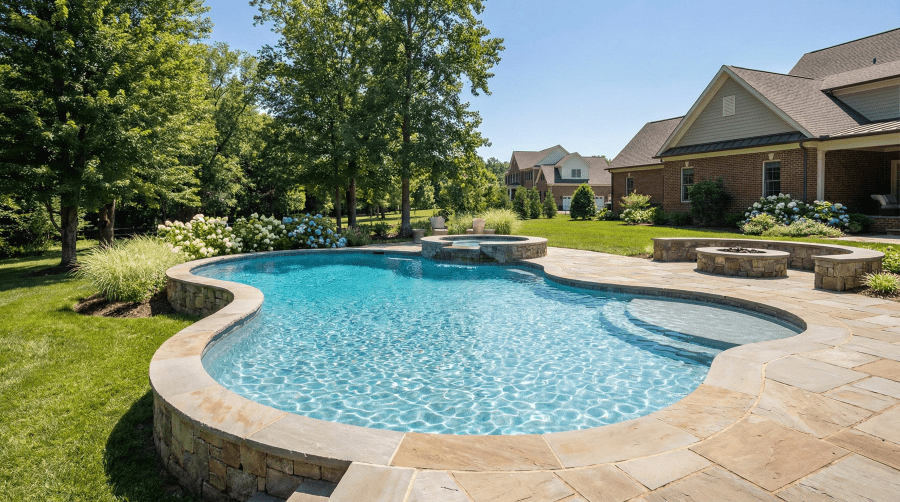
If you’ve started researching custom pools, you’ve probably come across the word gunite and thought, “Okay, but what exactly does that mean?” It’s one of those industry terms that gets used constantly but rarely gets explained in plain language. So let me break it down for you the way I’d explain it sitting across from you at your kitchen table.
I’ve been building pools in Northern Virginia for years, and gunite is the only construction method I use for custom pools. That’s not an accident. When a homeowner asks me why, I always say the same thing: because it’s the most durable, most flexible, and most long-lasting option available. But before I get ahead of myself, let’s start at the beginning.
The Basic Idea
Gunite is a type of concrete that is mixed dry and then combined with water as it’s sprayed through a high-pressure nozzle directly onto a framework of steel rebar. The result is a dense, reinforced shell that takes whatever shape your pool design calls for. Each gunite pool is built from scratch, right in your backyard, to your exact specifications.
That’s the short version. But there’s a lot more worth understanding if you’re considering investing in a pool that will be part of your home for decades.
How a Gunite Pool Is Actually Built
The process starts long before any concrete gets sprayed. It begins with a design consultation where we figure out exactly what you want. Shape, depth, features like steps and benches, spa integration, tanning ledges, waterfall elements, all of that gets planned out before we ever break ground.
Once the design is finalized and permits are pulled, excavation begins. We dig out the exact footprint of your pool. Then our team installs a grid of steel rebar that follows the contours of your design. This rebar skeleton is essentially the bones of the structure. It’s what gives a gunite pool its strength and allows it to hold its shape for the long term.
After the steel is in place and inspected, the gunite gets applied. A nozzle operator moves methodically across the entire surface, building up layers of the concrete mix until the walls and floor reach the required thickness. This part requires real skill. An experienced nozzle operator knows how to read the surface, maintain consistent thickness, and work around curves and transitions without leaving weak spots.
Once the shell is cured, the project continues with plumbing, electrical, and equipment installation. Tile gets set around the waterline. Coping is installed around the top edge. And finally, a finish coat is applied to the interior surface, which is what you’ll actually see and touch when the pool is full of water. That finish can be plaster, pebble aggregate, quartz, or other materials, each giving a different look and texture.
Why the Design Freedom Matters
This is the part that gets homeowners genuinely excited once they understand it. Because gunite is applied by hand and builds on a custom steel framework, there is almost no limit to the shape, size, or features your pool can have.
Want a freeform pool that follows the natural contour of your yard? Done. Want a long, narrow lap pool with clean geometric lines? Done. Want a shallow sun shelf on one end, a deep conversation area in the middle, and a spa elevated above the pool level on the other end? All of that is achievable with gunite because the design is built completely from scratch around your vision.
I’ve built pools on hillside lots in Gainesville where we had to work with challenging grade changes. I’ve built pools in tight backyards in Haymarket where the design had to be creative to maximize every square foot. Gunite handles all of it because the construction adapts to the site, not the other way around.
Gunite vs. Concrete: Are They the Same Thing?
This is a question I get often, and it’s a fair one. Gunite and shotcrete are both forms of pneumatically applied concrete, and you’ll sometimes hear the two terms used interchangeably. The technical difference is that gunite is a dry mix combined with water at the nozzle, while shotcrete arrives pre-mixed and wet before being sprayed.
Both methods produce a strong, durable pool shell. When a pool builder says they build “concrete pools,” they typically mean gunite or shotcrete construction. The key thing to understand is that this category of pool is structurally different from vinyl liner and fiberglass in ways that matter over the long term.
How Long Does a Gunite Pool Last?
With proper care, the structural shell of a gunite pool can last the lifetime of your home. The concrete and steel framework don’t wear out the way other materials do. What does require periodic attention is the interior finish, which typically needs to be replastered or refinished somewhere in the range of every ten to twenty years depending on the material used and how well the water chemistry has been maintained.
That’s an important distinction to understand. When people hear that a gunite pool needs maintenance, they sometimes assume that means the whole pool is wearing out. It’s not. Replastering the interior surface is routine upkeep on a structure that is fundamentally sound. Think of it the way you’d think about repainting the interior of your home. The house itself isn’t failing. You’re just refreshing the surface.
What About the Timeline and Cost?
I want to be straightforward with you here because I think some builders aren’t. A gunite pool takes longer to build and costs more upfront than a fiberglass pool. That’s just true. A custom gunite build typically takes several weeks from excavation to water, accounting for the cure time the concrete requires and all the work that happens after the shell is complete. Fiberglass pools have a faster installation timeline, and that’s a legitimate advantage depending on what matters most to you.
The cost reflects the craftsmanship involved. Every pool is built by hand, by skilled tradespeople, from scratch. You’re also paying for longevity and the ability to customize in ways that simply aren’t possible with prefabricated options. Most homeowners who do their research understand that the upfront investment in a gunite pool pays off over the decades they’ll spend enjoying it.
That said, I always encourage homeowners to get a real conversation going before making any assumptions about budget. There’s a wide range within gunite construction depending on size, features, and site conditions. What I can tell you is that I will never give you a number that doesn’t reflect the actual scope of your project.
What Gunite Pool Owners Should Know About Maintenance
Owning a gunite pool is not complicated, but it does require consistent attention. Water chemistry is the most important thing. Gunite surfaces are porous to some degree, which means that if your water is out of balance for extended periods, it can affect the interior finish over time. Keeping your pH, alkalinity, and sanitizer levels in the right ranges protects your investment.
Regular brushing of the walls and floor helps as well. Unlike fiberglass surfaces, plaster and pebble finishes benefit from brushing because it keeps algae from taking hold and helps maintain a smooth appearance.
In Northern Virginia, you also need to think about winterization. Our winters can push the soil in ways that affect pool structures if they aren’t properly closed for the season. A good pool professional will walk you through the right closing process for your specific setup. Done properly, a gunite pool in our region handles the freeze-thaw cycle without issue.
Is a Gunite Pool Right for You?
Honestly, it depends on what you’re looking for. If you want a pool that’s fully custom, built to last a lifetime, and can accommodate almost any feature or design you have in mind, then gunite is absolutely worth the investment. If a fiberglass pool is a better fit for your goals, your timeline, or your budget, that’s a completely valid direction too, and it’s one we can help with. We offer fiberglass pools as well because we want homeowners to end up with the right pool for them, not just the one we happen to build.
What I find is that most homeowners who come to me have already done enough research to know they want something built to their specific vision. They’re thinking about how this pool will look in their backyard for the next thirty years. They want it done right. For those homeowners, gunite is consistently the answer.
The Bottom Line
A gunite pool is a hand-built, reinforced concrete structure designed to your exact specifications and built to last for the long haul. It takes more time, more skill, and more investment than other pool types, and in return it gives you design freedom and structural durability that can’t be matched.
If you’re in the Gainesville, Haymarket, Bristow, Warrenton, or surrounding Northern Virginia area and you’re thinking seriously about a pool, I’d encourage you to have a real conversation before making any decisions. Not a sales pitch. Just a conversation where I can understand what you’re looking for and give you an honest picture of what the process looks like.
That’s what I built Relax Pools around. Confidence, craftsmanship, and trust. And it starts with making sure you have the information you need to make a good decision.
Ready to talk? Reach out and let’s schedule a consultation.